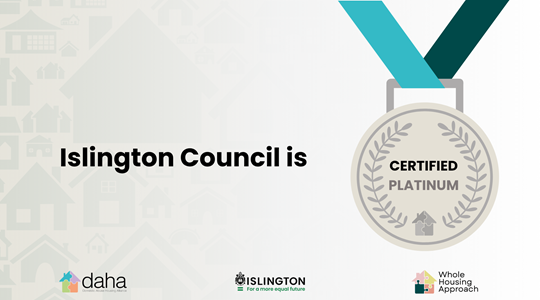
Islington Council are DAHA Platinum Accredited
Find out more
Your message is important to us, we will be in touch shortly.
Find out more
Find out more
Find out more
Find out more
Find out more
We are proud to celebrate Islington Council as the first London borough to be awarded Platinum Accreditation by the Domestic Abuse Housing Alliance (DAHA) — a groundbreaking milestone that sets a new benchmark in housing sector excellence under the Whole Housing Approach.
This prestigious recognition reflects Islington’s exceptional leadership in creating a whole-system response to domestic abuse, placing survivors' voices and lived experiences at the heart of housing practice. From early intervention to long-term safety and stability, Islington has demonstrated what’s possible when trauma-informed, survivor-centred, and justice-driven approaches are embedded across services.
Key to this transformation has been:
As Ian Swift, Director of Housing Operations & Deputy Corporate Director at Islington Council, powerfully shared: “This is not the end — it’s the beginning of the beginning. If Islington can do it, any borough can.”
This achievement not only celebrates Islington’s innovation and commitment but serves as a call to action for other boroughs and housing providers. The Platinum Accreditation shows how housing can be a platform for healing, not harm, and how bold leadership can turn policy into life-changing practice.
Congratulations to all the internal champions, survivors, and staff whose unwavering dedication made this moment possible.
Together, we raise the bar — and the standard.
Standing Together Against Domestic Abuse & DAHA respond to the Prime Minister's Announcement on removing the local connection test for survivors.
We welcome the Prime Minister’s announcement at the Labour Party Conference this week that domestic abuse victims will now have the right to apply for social housing in any local authority across the country for life.
A home isn’t always a safe place. For many survivors escaping abuse means leaving their local authority area to be safe. We have long highlighted the inconsistency between local authorities across England in meeting their obligations to house women fleeing domestic abuse from another local area.
Guidance alone is not sufficient to address this issue. We have been advocating for a statutory bar on local authorities imposing local connection restrictions or ‘residency requirements’ within their homelessness duties and housing allocations policies for survivors. These frequently and disproportionately harm those escaping domestic abuse, often forcing them to remain in unsafe situations. By eliminating these barriers, we can ensure that survivors have choices and greater access to the vital resources they need to rebuild their lives.
Our response to the previous government’s consultation on local connection submitted in May 2022, highlighted how these requirements limit the choices and opportunities available to survivors. The announcement from the Prime Minister yesterday aligns with our vision for a more compassionate and effective housing policy. It is a significant step for survivors face when they seek safe and stable housing.
We call on Government to implement this swiftly. Local authorities must be equipped to support survivors to access the housing they need. Standing Together, we can and must create safer, supportive environments for those who experience domestic abuse.
Cherryl Henry-Leach
Chief Executive Officer,
Standing Together Against Domestic Abuse
Press Release
We call on the Government to protect survivors of domestic abuse and all vulnerable tenants in the upcoming Renters’ Rights Bill
The National Housing and Domestic Abuse Policy and Practice Group ("the Group" brings together experts from the housing, domestic abuse, and violence against women and girls’ (VAWG) sectors from commissioning, charity, and policy perspectives. We support statutory agencies, government departments, and the private sector to deliver safe and suitable housing for survivors of domestic abuse.
As the UK Government prepares to introduce the Renters’ Rights Bill later today, there is so much to welcome, we await to see the details and the Group is urging the Government to ensure that any new legislation considers and adequately protects survivors of domestic abuse. While the proposed Bill includes important measures to strengthen tenant protections, we highlight the critical need for specific provisions to address the unique challenges faced by domestic abuse survivors.
We support the ending of all unfair evictions, making renting safer, and ensuring affordability. However, we stress that tackling rising rents, scrapping Section 21 ‘no-fault’ evictions, and enforcing stronger standards must also include specific safeguards for survivors of domestic abuse. This includes preventing the misuse of ASB complaints as a tool to evict those fleeing abuse.
In our submission to the previous government’s Renters (Reform) Public Bill Committee, we emphasised that domestic abuse survivors are three times more likely to have an Anti-Social Behaviour (ASB) complaint lodged against them. Misidentifying domestic abuse as ASB can lead to unjust evictions, further endangering survivors. We call on the government to adequately address this issue within the new legislative framework.
DAHA with the Group also welcomes the government’s proposals to strengthen local authorities’ enforcement powers and establish a new ombudsman service. However, we urge that these measures be complemented by increased support for survivors, including better access to legal aid and resources for local authorities to uphold tenants’ rights effectively.
As the Renters’ Rights Bill progresses, DAHA will continue to advocate for the protection and empowerment of domestic abuse survivors, ensuring they are not left vulnerable within the private rented sector. The Government must grab this opportunity to create a fair, safe, and supportive housing environment for all renters, particularly the most vulnerable.
We very much look forward to seeing the details of the new Bill and to working with the Government on the details so that the Group can be confident that every victim/survivor of domestic abuse can access safe and secure housing.
For media enquiries, please contact:
Judith Vickress
Head of Housing
Standing Together Against Domestic Abuse
j.vickress@standingtogether.org.uk
About Standing Together and DAHA:
The Domestic Abuse Housing Alliance (DAHA) is part of the Housing Team programmes within Standing Together Against Domestic Abuse, a national charity bringing communities together to end domestic abuse. The DAHA Programme is dedicated to improving the housing sector’s response to domestic abuse. Through accreditation, training, and advocacy, DAHA works to ensure that every survivor of domestic abuse can access safe and secure housing.
18 May 2023
Yesterday, the long-awaited Renters Reform Bill had its first reading in Parliament, fulfilling many of the ambitions set out within the Renters Reform White Paper, to ‘reset the balance of rights and responsibilities between tenants and landlords’. The most prominent and welcomed aspect of the bill is the end of Section 21 ‘no fault’ evictions, which has caused housing insecurity and homelessness for many private renters, including victims of domestic abuse living in the private rented sector (PRS).
There are now more victims of domestic abuse living in the PRS than ever before, in part due to the growth of the PRS, but also due to a significant lack of social housing, with many victims of domestic abuse having no other choice but to take on PRS tenancies, which have often been insecure, unaffordable, and, unsafe. In the context of a cost-of-living crisis, including soaring rents, and local housing allowance rates that do not meet rental demands, many victims of domestic abuse (many of whom are single women with children) are placed in positions of great hardship and the risk of homelessness, in addition to the ever-present threat of harm and homicide.
By removing Section 21 ‘no fault’ evictions, and the government’s commitment to take future action to address discrimination against tenants with children, we hope victims of domestic abuse will face fewer housing barriers to achieving safety. However, we continue to be concerned that this will be undermined by the changes proposed within the bill to make it easier for landlords to evict on grounds of anti-social behaviour (ASB) and rent arrears. This includes, broadening the discretionary ASB ground for eviction to ‘’any behaviour capable of causing nuisance or annoyance’’ as well as introducing a new mandatory ground for repeat serious arrears, as detailed within the White Paper.
Victims of domestic abuse are significantly more likely to have ASB complaints made against, often due to the misidentification of domestic abuse as ASB. Victims of domestic abuse are also more likely to be in rent arrears, both as a direct result of economic abuse, and due to the economic and practical burden of fleeing abuse and becoming homeless, often with their children (victims of domestic abuse in their own right). With no proposed safeguards in place to protect victims of domestic abuse from evictions related to domestic abuse, we fear this will lead to harm and homelessness. As a result, victims of domestic abuse may become more dependent on their abuser and make it even more difficult to leave.
We have worked closely alongside the DAHA-led National Housing and Domestic Abuse Policy and Practice Group to publish a detailed briefing on the impact of the proposed changes through the RRB on victims of domestic abuse in cases of ASB. We make clear recommendations for how the government can safeguard victims of domestic abuse and other vulnerable tenants, including those at risk of other forms of abuse or exploitation or in need of health or social care support. These recommendations included:
We look forward to further scrutinising the bill, which will undoubtedly lead to further recommendations from our National Group, particularly in the areas of rent arrears. We want to work with sector partners, government, and parliamentarians to ensure the bill works to protect all renters, which must include victims of domestic abuse living in the PRS who already face far too many barriers to safety and housing insecurity.
For more information and any press enquiries, please contact the DAHA National Group Chair and Senior Housing Manager, Deidre Cartwright, by emailing: d.cartwright@standingtogether.org.uk
Today, our DAHA-led National Housing & Domestic Abuse Policy & Practice Group published a joint briefing on domestic abuse and the Renters (Reform) Bill, in hopeful anticipation of its second reading in parliament.
While we support several aspects of the bill, we remain greatly concerned that proposed changes to anti-social behaviour and repeat rent arrears eviction grounds will place victims of domestic abuse at a greater risk of harm and homelessness. As a result, victims of domestic abuse may become more dependent on their abuser and face greater barriers to leaving.
In our briefing we make clear recommendations for how the government can ensure victims of domestic abuse are not placed at risk of eviction because of their experiences of domestic abuse, due to rent arrears and the misidentification of domestic abuse as anti-social behaviour.
Please read and share our briefing, support our recommendations, and raise the profile of this important issue.
Briefing link: https://www.dahalliance.org.uk/media/11293/renters-reform-bill-briefing_june23.pdf
Loading...